THAILAND TOURISM · PRODUCT HACKATHON
Thai Unseen
A bilingual, multi-sided tourism business concept connecting traveler demand with hidden gems, local guides, community businesses, travel buddies, and transparent transport.
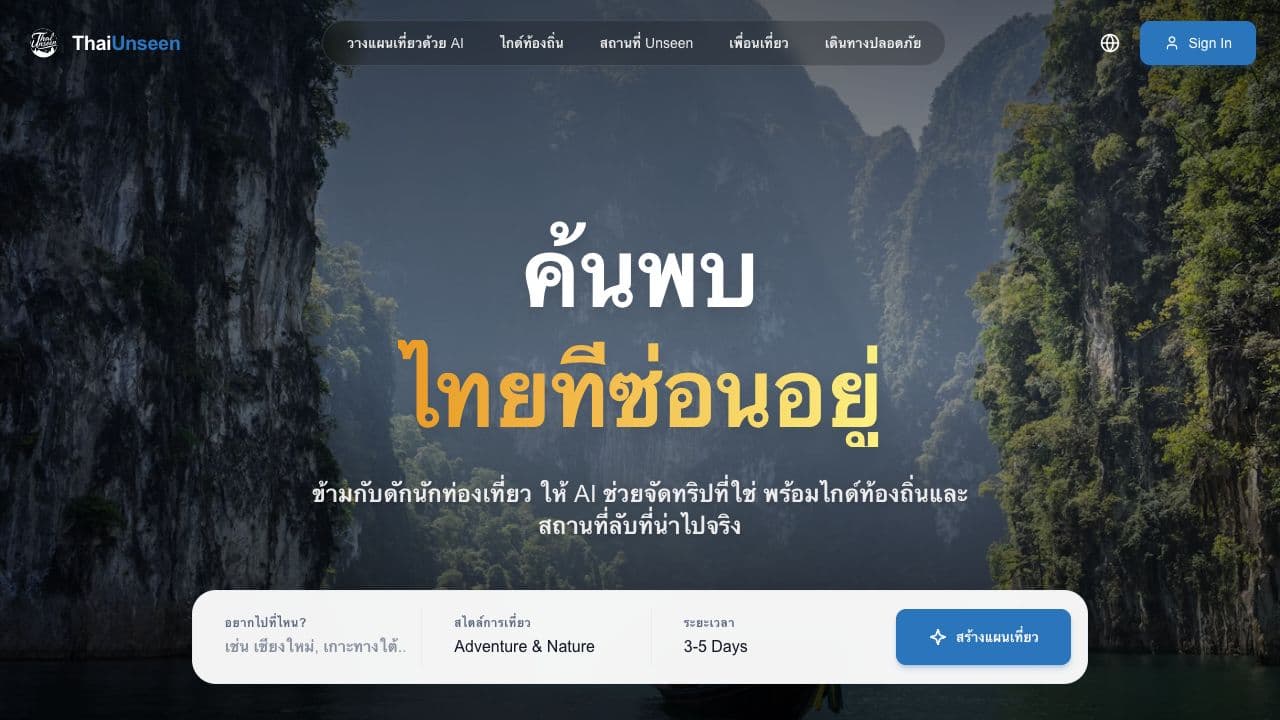
The problem behind the interface.
The challenge was broader than designing another destination directory. Thai Unseen explores a multi-sided platform where travelers receive trustworthy discovery and planning, while local guides, drivers, and community businesses gain visibility and access to demand. I translated that business hypothesis into a responsive, bilingual prototype with connected discovery, matching, provider, buddy, and transport experiences.
What I owned,
not only what the team shipped.
Responsibilities are written as decisions and deliverables so the individual contribution stays visible.
Mapped the value proposition across travelers, local guides, community businesses, and transport providers.
Translated the business concept into a connected traveler journey from inspiration through planning and local connection.
Built the responsive Next.js / TypeScript interface and reusable product components.
Implemented the route-matching interface and explainable scoring prototype around traveler constraints.
Connected discovery, provider supply, transparent pricing, and bilingual content into one demonstrable product.
From raw signal
to useful response.
A simplified architecture showing how information changes as it moves through the system.
Attract
Traveler intent and hidden demand
→Match
Places, guides, businesses, and rides
→Connect
Trusted providers and fair pricing
→Circulate
More value reaches local communities
Designed around
the real constraint.
Features matter here because each one answers a workflow, data, or operational constraint.
A multi-sided tourism business ecosystem
Framed distinct value for travelers, local guides, community businesses, and drivers: trusted discovery for demand, and visibility plus booking opportunity for local supply.
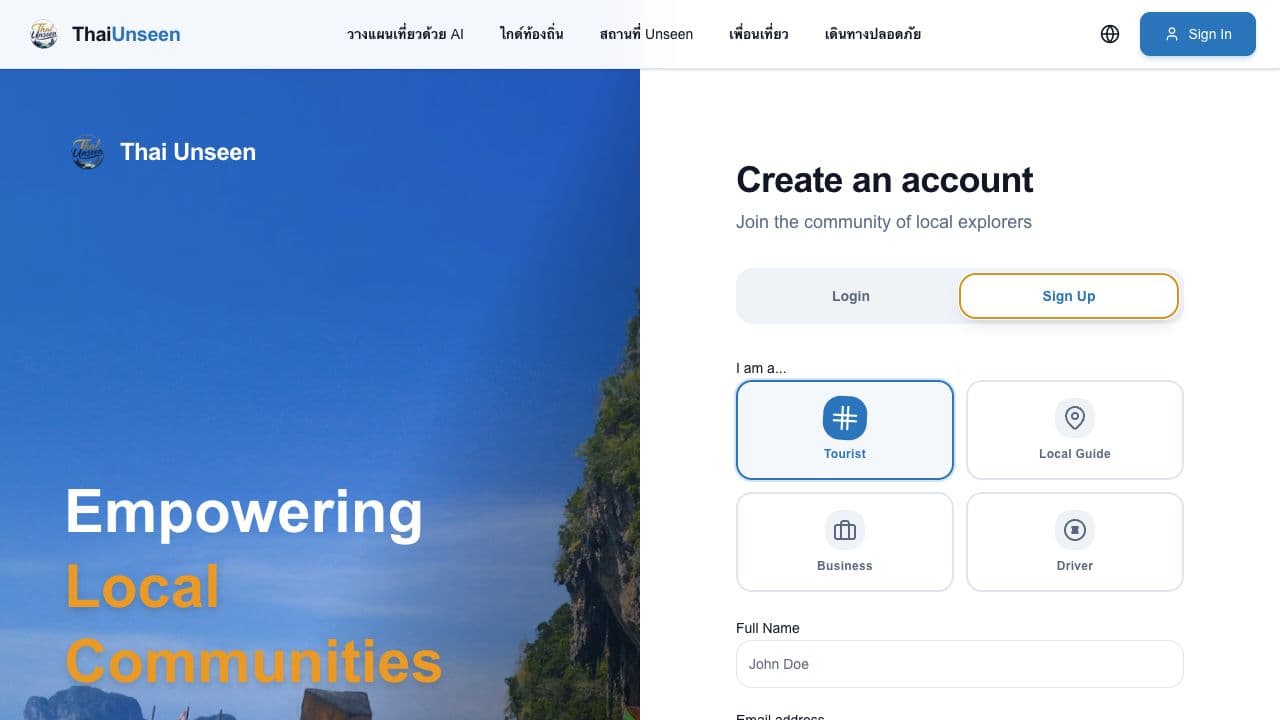
Route matching around the traveler
Built a route-search prototype that scores places using the search intent, starting area, interests, budget, distance, and route fit.
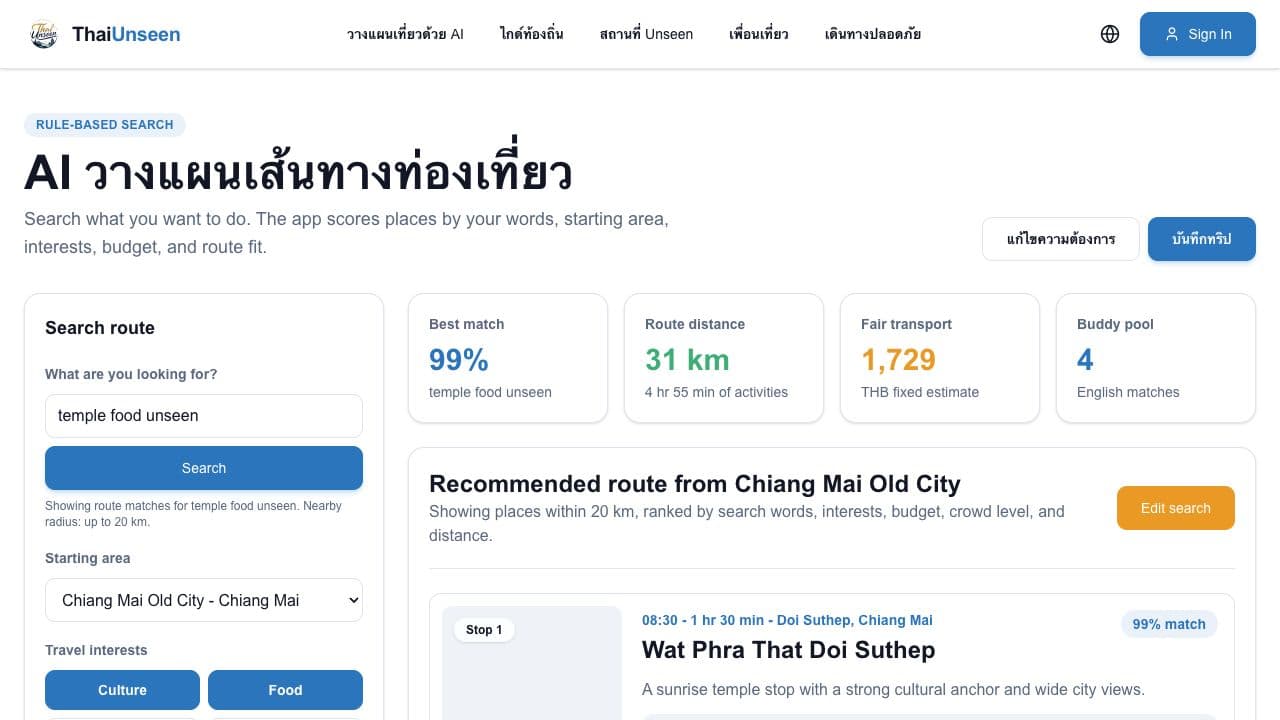
Hidden gems as a discovery experience
Organized lesser-known destinations into an approachable visual discovery flow across nature, culture, beaches, history, and food.
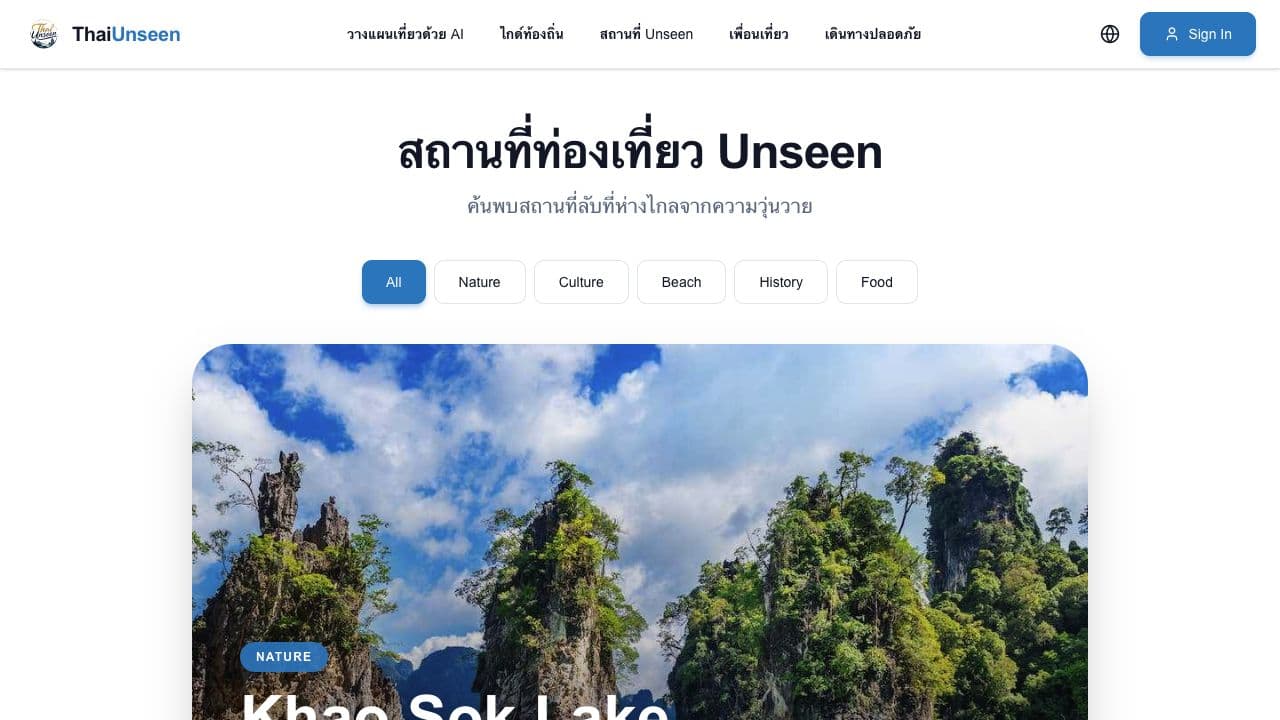
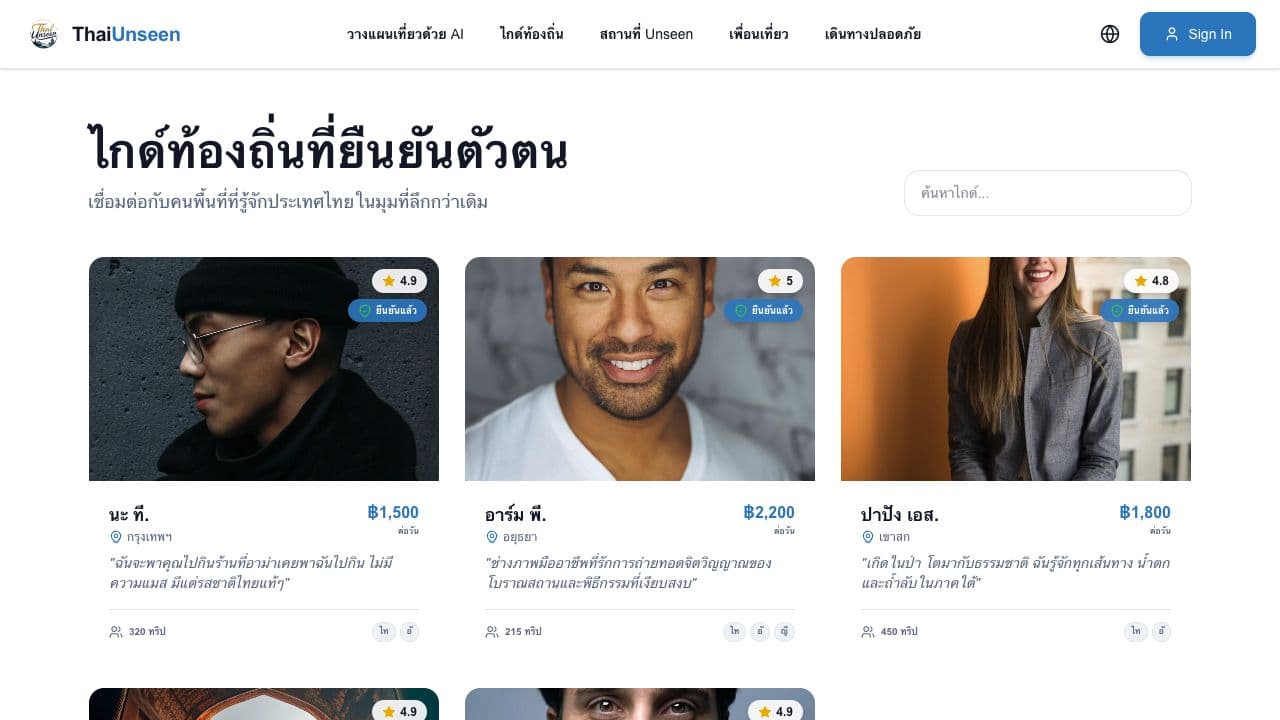
Local connection, not only destination content
Extended the journey beyond places with verified local guides, travel-buddy matching, trip planning, and transparent transport concepts.
Bilingual, reusable product foundation
Structured reusable React components and a custom TH / EN dictionary so the prototype could present one coherent experience to domestic and international travelers.
What can be claimed.
What still needs proof.
Useful engineering separates observed evidence from interpretation and future validation.
The core product journeys are deployed and can be explored interactively.
Tourists, guides, businesses, and drivers have distinct entry points and value propositions.
The interface supports Thai and English through a reusable dictionary structure.
Known limitations
- Route recommendations currently use curated data and explainable rule-based scoring rather than a learned recommendation model.
- Guide verification, booking, messaging, authentication, and payments are prototype flows rather than production integrations.
- Revenue model, provider acquisition cost, take rate, and marketplace liquidity remain unvalidated business hypotheses.
- Recommendation relevance and usability have not yet been validated with a representative traveler study.
Next engineering steps
- Evaluate a hybrid recommender combining traveler constraints, semantic place retrieval, and transparent ranking signals.
- Validate willingness to pay, provider onboarding, transaction economics, and an appropriate commission or partner-revenue model.
- Persist traveler preferences, providers, and trip state in a production data model with secure access controls.
- Run task-based usability and recommendation-quality evaluation with Thai and international travelers.